zaterdag 14 januari 2012

Buying vs Renting

Recently I had a heated discussion about which one is better: buying a house or renting a house.

I kept saying that renting a house was cheaper than buying a house and here's why:
- The government will not keep subsidizing your loan
- Housing prices will not forever keep going up faster than the rise of wages
- Gold will increase much faster than real estate due to inflation
- Taxes on property are high and will keep increasing
- Maintenance on property needs to be paid by the owner of the house 
- Mortgages will rise in interest rate and will collapse the price of houses

I found a nice site that calculates the expenses: Renting VS Buying

If we make following assumptions:
- The average rent of an appartment in Belgium: 715 euro/month (2010) (house rent)
- The average price of an appartment in Belgium: 215000 euro (2010) (house price)
- Inflation rate: 3.5%
- Mortgage interest rate 5.5%
- 30% down payment
- Rent inflation 3.5%
- Interest on investment in gold: 5%/year (gold will at least triple in price in 30 years)
- 30 year mortgage
- Maintenance 1000 euro/year
- 6450 euro closing costs 
- 2300 euro tax/year
- Depreciation of house: 1% a year (your appartment will lose value year over year due to style that gets old and due to the fact that people will pay less for a house that has been lived in for 30 years)


Conclusion:
Buying does not become better than renting during the first 30 years.

Here's how much you're out under each scenario:
 $480,804 to buy the house.
 $189,411 from renting if you invest the difference.
 $575,490 from renting if you don't invest.

If you rent and religiously invest the difference between what you would have paid for a house and what you're paying in rent, you can earn a return of $386,078 (after taxes). This helps make renting a better deal.


BuyingRenting
$674,112$575,490Cash spent
-$206,746Home value
$13,439Closing costs on resale
$480,804$575,490Net spent
(if not investing)
(lower number wins)
-$386,078Less return on investment
$480,804$189,411Net spent
(lower number wins)

vrijdag 13 januari 2012

M1 and M2 still rising

M1 is the total currency in the banks + checking accounts.
M2 = M1 + savings accounts, funds

Money supply measures the amount of currency in circulation in the economy and is, as a consequence, a measure of future inflation. If you would think that the government isn't still printing money, I need to dissapoint you. M1 and M2 are still rising at an exceptionally fast pace. Which is very inflationary in the future.

M1

M2

Baltic Dry drops

The Baltic Dry Index is an index of dry shipping lease rates. It reflects how much it costs to rent a freighter for hauling non-liquid raw materials. There is a high correlation between BDI and the Chinese economy. If the BDI drops, the commodity trade drops, together with the Chinese economy.

The last few weeks the Baltic dry Index dropped quite a bit, which indicates a slowdown in the Chinese economy with its commodity trade. Even the Panamax and Supramax (for smaller ships) is dropping, which confirms the slowdown in every sector of the freight transport economy.

This will be bad for industrial commodities going forward. I wouldn't rule out silver correcting downwards, if this trend continues.

Baltic Dry

Baltic Panamax

Baltic Supramax


A possible reason for this drop could be the drop in prices of Chinese properties as can be seen on the Shanghai Property index:

Shanghai Property Index

dinsdag 10 januari 2012

Belgium housing bubble

The Economist has a nice interactive tool to monitor the house prices from 1975 till 2012: http://www.economist.com/node/21009954

A few interesting observations can be made:

Belgium, where I'm living, is still in an upward trend in housing prices (Chart 1), while this can't be sustainable if we look at house prices against average income (Chart 2). Historically housing prices can only go up when wages go up, because you can't buy a house when you don't earn enough money to buy it/pay it off. I am expecting a similar drop in housing prices in Belgium like what has happened in the US in 2008.

In the United States, we see the collapse starting in 2007 and bottoming out in 2009.

In Japan, we see that house prices are becoming really cheap for Japanese people to buy, which is actually a good thing.

In Hong Kong we also seem to have a housing bubble forming.

Chart 1: House prices in real terms
housing prices in real terms


Chart 2: House prices against average income
Housing prices real income


Katchum's Economic Intermezzo

Welcome!


If you are reading this article, you will be one of a few privileged people, able to prepare for the tsunami that's coming to us. We live in one of the most exhilarating times of the past few centuries and that's because the future, starting from 2012, will never be the same as before. We are faced with the limits of our existence concerning debt, money supply, commodities, exponential growth, population, energy and war.


If you haven't seen this curve of base money yet, it's time to take notice of it (Chart 1). This chart shows the amount of base money (billion USD) that has been printed by the federal reserve. It was relatively flat in the beginning of the century and started to move upwards in the 1970's when the gold standard was abandoned. But it really started to explode in 2008, during the financial crisis that we all have experienced ourselves. This is the first sign of coming inflation. Our money will diminish more and more in value because money is being printed increasingly by governments around the world.


Chart 1: Base money supply and Ben Bernanke (Federal Reserve)


The following chart shows the federal US external debt:


Chart 2: US federal external debt
U.S. Federal External Debt
If you look closely, the debt is accelerating at a perfectly exponential pace, which is completely unsustainable. Something has to give and ultimately we will see a first sign of hyperinflation.

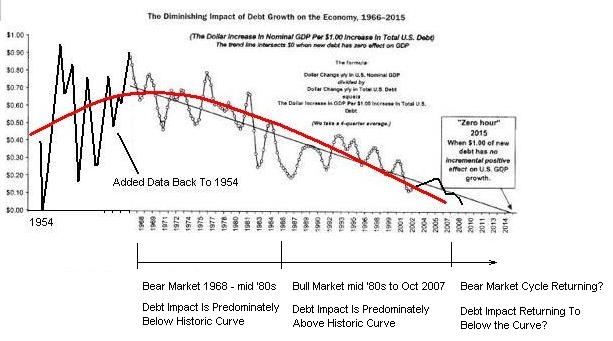
We are in 2012, the time where additional debt doesn't grow the economy. Which means you need to print an eternal amount of money to grow GDP. This gives us the second sign of hyperinflation. To prove this statement I'll show you this chart 3: "Zero Hour".

Chart 3: Zero Hour
Zero Hour
The "Zero Hour" chart shows us the amount of GDP growth (Y-axis) that you will get by adding 1 USD of debt to the government's balance sheet. For decades we could just print money and grow the economy.

In 2012 - 2014 unfortunately our luck is over. Printing money will not grow the economy anymore! That's the reason why debt is going up exponentially (see chart 2). It takes an infinite amount of debt to get us out of trouble. Which means it's over with, we've finally reached the limit.

A third sign of coming hyperinflation is shown in chart 4: "Level of deficits relative to government expenditures." This chart shows the government spending (pensions, medicare, social security) compared to foreign debt. 


=> For every 100 USD the US government spends, 40 USD is borrowed from Asia, Europe, etc...

Historically, once we reach 40%, we start a period of hyperinflation. In 2012, the USA already reached 60%...


Chart 4: Deficits relative to government expenditures (%)
us japanese deficits


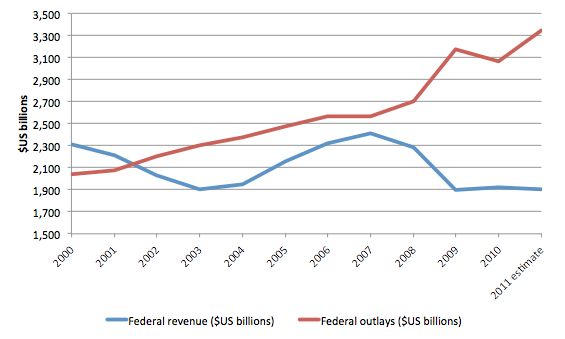
Another sign of the imminent collapse of the USA is shown in Chart 5 where the government is spending too much money, while having less and less revenues.

Chart 5: US Federal Expenditures vs Revenues
Outlays Spending


A financial collapse will ultimately start happening and we can already see evidence of this in the bond markets in Europe. This is why you shouldn't place your hard earned money in the bank.

Consider that the 1 Year German government bond yields are going under zero (see Chart 6). Would you place your money in a bank with interest less than 0%?

It is amazing that people want to lend money to the German government while paying extra money (0,02% of their investment) a year from now. Thereby losing money with their investment.

I can think of only one reason for this and that is: "Your money is not safe in the bank".

Why would someone not just put their savings in a bank which pays around 1,5 % yield a year. Instead they want to lose money by buying German government bonds. Exactly because your cash is not safe in your bank. At any time your bank will go bankrupt. Germany is a safe haven, so people flee to that country. But there are far better alternatives which I will talk about next on.


Chart 6:
1 year german government bond


Completely the opposite is the 1 year Greece Government Bond Yield (see Chart 7), which is surging past a record 380 %, which basically means a default on their debt. And a collapse in Greece means a collapse in the banking industry.

Chart 7:
1 year Greece government bond yield


It amazes me that people still buy these government bonds, knowing that the bond bull market is coming to its end.

US government bond yields have run a 30+ year bull market (1980-2012). I think it's time for the market to start moving the money from government bonds to precious metals.

Which takes me to the ultimate safe haven: Gold and Silver!

During hyperinflation, the best way to protect yourself is to buy precious metals like gold and silver. There are many reasons to do so.

The first one is because of a complete depletion of commodities in about 20 years from now (see chart 8). Especially silver (Ag) will become scarce and ultimately will be depleted in about 11 years if we keep growing exponentially. Oil will double in price in about 2 years from now due to production decreases (peak oil theory).

Chart 8: Commodity depletion
depletion

In the beginning of 2012 a very interesting event happened in the silver market. The premium over spot price of a certain silver trust (PSLV) surged to 34%. Why would people buy silver at such high premiums? That's because the silver price is about to start surging upwards.

Chart 9: Silver premium/price
Silver premium (%) blue dots, Silver Price (USD) red dots
Much like silver, gold is ultimately the best store of value. If we consider the amount of money the US federal reserve has printed, gold is still very cheap historically, which is the second reason to buy gold. If we calculate the Gold Money Index as:

GMI = Central bank foreign exchange reserves (USD) / Central Bank Gold Reserves (ounces)
                                      
Then the gold price would have to go to 12000 USD. We are at 1600 USD so that's an eightfold increase!

With the problems in the Eurozone I would be very wary about staying in cash. Chart 10 tells us that Belgians would lose 23,9% of their money if they would go back to the Belgian Frank. This is the third reason to buy gold.


Chart 10: Fair value during breakup of Euro

And finally the last reason to buy gold: during the Great Depression everything collapsed (real estate, oil companies, stocks, bonds, cash). The only things that surged were gold and gold mining companies. A similar event happened in Iceland in 2008, the last man standing was gold.

We can already see turmoil in the whole world. USA is starting a war against Iran. China and Japan get out of the US dollar trade. Russia sells out on 70% of their US government bonds. Occupy Wall Street happens. Greece is in chaos...

Conclusion: Enjoy the beauty of life while it lasts and buy gold/silver. 

Follow me at: katchum.blogspot.com

maandag 9 januari 2012

Government Bond Yield Extremes

Today I found an interesting article on Bloomberg about 1 Year German government bond yields going under zero (see Figure 1).

It is amazing that people want to lend money to the German government while paying extra money (1% of their investment) a year from now. Thereby losing money with their investment.

I can think of only one reason for this and that is: "your money is not safe in the bank".

Why would someone not just put their savings in a bank which pays around 1,5 % yield a year. Instead they want to lose money by buying German government bonds. Exactly because your cash is not safe in your bank. At any time your bank will go bankrupt. I know Germany is a safe haven, but there are far better alternatives here like buying precious metals: gold and silver.


Figure 1:
1 year german government bond


The 1 year US government bond yield is really almost the same. Amazingly low yields with minimal return in an inflationary environment (see Figure 2).

Figure 2:
1 year US government bond


Completely the opposite is the 1 year Greece Government Bond Yield (see Figure 3), which is surging past a record 380 %, which basically means a default on their debt.

Figure 3:
1 year Greece government bond yield


It amazes me that people still buy these government bonds, knowing that the bond bull market is coming to its end.
US government bond yields have run a 30 year bull market (1980-2012). I think it's time for the market to start moving the money from government bonds to precious metals.