zaterdag 7 juli 2012

Denmark: Negative Interest Rates

It's amazing that central banks actually started to send key interest rates below 0%.
Denmark just put the key interest rate to -0.2%. 

Of course, they have no choice as the Danish krone is pegged to the euro.

Chart 1: EUR/DKK


See Moneybags' video below:


Allana Potash: Update

Agriculture has been in a bear market since February 2011 as evidenced by the Rogers Commodity Index for Agriculture (RJA). But surprisingly, since June 2012 something interesting happened. We got a spike of 16% in the agriculture price due to supply concerns in the corn, soybean and wheat market (Chart 1). This spike is also felt in stocks like Potash Corp. of Saskatchewan (POT) and Mosaic Company (MOS). As agriculture prices increase, so will the fertilizer prices increase.

Chart 1: Rogers Commodity Index Agriculture (RJA)
Agriculture is one of the sectors I'm very bullish on and it's not just me. Marc Faber's recent outlook for agriculture has been very positive. Marc Faber expects more weakness in industrial commodities, though he said agricultural commodities "look better".

In the past year, fertilizer developers have been decimated. One of these developers: Western Potash ( (WPSHF.PK ), had additional problems due to development doubts in their project due to market speculation that a deal with a potential Chinese investor in the company fell through. Another company, Ethiopian Potash (FED) has been on the brink of collapse due to its dire financial situation. And more recently, BHP has been exiting Ethiopia due to weak exploration results.

On the other hand, Allana Potash (ALLRF.PK), which I talked about in this article, had increasingly positive news over the past year. Though, the share price hasn't increased yet (Chart 2).

I will give a quick update on Allana Potash in this article.

Copper Price VS. Contango Report

I decided to start monitoring the contango-backwardation curve of copper (Chart 1). In a previous article I noted a pretty significant correlation between contango and price of copper.

We see that the negative correlation between copper price and 1 yr futures contango is still existing. But it's difficult to predict the price of copper, because the contango curve and the price curve are almost exactly following each other. We could say we almost have a 100% correlation here.

But, something weird happened on 14 May 2012 though, where the copper price was in steep backwardation, but the copper price didn't go up... So there still are discrepancies in this correlation.

Let's see if this monitoring of the copper contango will bring new ideas.

Chart 1: Copper Price-Contango (USD/lb)

donderdag 5 juli 2012

Silver Net Short Positions Hit Record Low Again

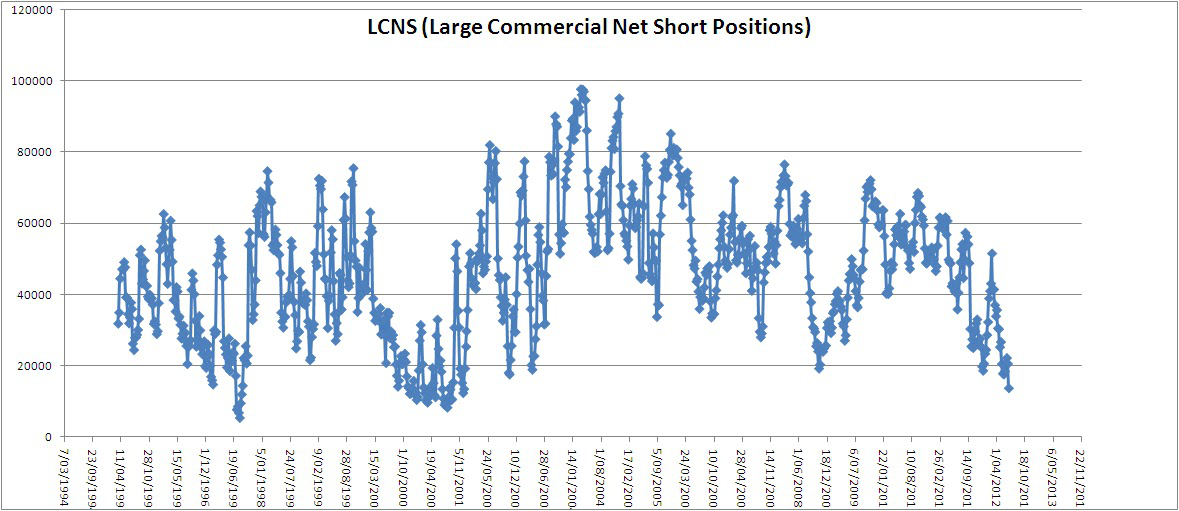
In my previous article about net short silver positions I said that silver would explode upwards once the net silver short positions started to increase.

Today the June 2012 numbers came out and we see that the net short positions have not gone in an uptrend yet. 

So we wait..., until the spring suddenly unwinds.

LCNS Net Short Positions Silver
Chart 1: LCNS Net Short Positions in Silver
Data: http://www.cftc.gov/OCE/WEB/data.htm

Baltic Dry Index Reacting to Iran Oil Embargo

Since Europe banned crude oil imports from Iran on 1 July 2012, the Baltic Dry Index has shot up 10% already from 1000 to 1103 (Chart 1). The reason for this spike isn't because Europe is banning crude oil imports from Iran, but rather the consequence of it. Due to this ban, Iran has renewed its threat to close the Strait of Hormuz. Approximately 20% of the world's oil, which is about 35% of seaborne traded oil, passes through this strait. As this strait is closed down, commodity transport vessels need to make a detour, which will increase the price of oil and increase the tanker rates. The availability of tankers will go down due to this forced rechartering of routes, which will decrease oil supply. As a consequence oil tankers will store oil in anticipation of rising oil prices and this will be beneficiary to the tanker industry. On 4 July 2012, the situation even got worse, with Iran threatening to strike 35 U.S. military bases within minutes. We will see that these events will be beneficial to the Baltic Dry Index and oil prices in general.

To read the full analysis go to my article here: Frontline: How to Profit from the Iranian Oil Embargo.

woensdag 4 juli 2012

France's 7.2 billion euro tax is a non-event

France just raised taxes on the rich and is trying to get 7.2 billion euro in tax revenue in 2012 and 33 billion euro in 2013.

So what does this mean to the deficit of France? France's GDP is 2.56 trillion euro. France's debt is 90% of GDP. Its total debt is therefore 2.3 trillion euro.

What is 7.2 billion on 2.3 trillion euro? It's 0.3%. So it basically does nothing to the French debt.

You could argue that it is a first step to decrease the yearly deficit. But the deficit is currently 70 billion euro/annum. So we have a 10% decrease in the deficit, which is a non-event. It's like an obese person trying to lose weight by eating a smaller hamburger with less french fries. He is still gaining weight, but at a slower pace...

For 2013 it is estimated that France will have a 50% decrease in deficit, but France will still have a deficit.

And I believe France won't be able to wait till 2014 to decrease the deficit, because Europe would be in much worse shape than today.

maandag 2 juli 2012

U.S. debt jumps by $US 75 billion overnight

U.S. debt jumped $US 75 billion overnight, which is a pretty big jump. Total U.S. public debt jumped from $US 15.781 trillion (28-Jul-2012) to $US 15.856 trillion (29-Jul-2012). The debt ceiling of $US 16.7 trillion is coming closer and closer.

Historically, the biggest jumps were $US 154 billion overnight on 31-Dec-2010, $US 166 billion on 30-Dec-2009 and $US 166 billion on 29-Jun-2010. Average jump in debt is $US 3.5 billion.

Chart 1: Total U.S. Public Debt

zondag 1 juli 2012

Euro Selling Has Stopped

The new numbers of the Currency Composition of Official Foreign Exchange Reserves (COFER) have been released and it shows that the the world has stopped selling euros (Table 1). Claims in euros have increased from $US 1.413 trillion to $US 1.423 trillion, an increase of 0.7%. Claims in U.S. dollars have increased from $US 3.513 trillion to $US 3.548 trillion, an increase of 1%. Interestingly, the increase in U.S. dollar claims is flattening out as compared to previous quarters, indicating U.S. dollar weakness.

In the previous three quarters, the claims in euros had been going down ($US 1.472 in Q2 2011 to $US 1.438 in Q3 2011 to $US 1.413 in Q4 2011). But that decline has stopped for now. I believe this reversal means that it's time to start buying into the euro again in the short term.
Table 1: Currency Composition of FOREX Reserves

To read the full analysis, go HERE.