When foreigners cut their positions in U.S. debt, the 10 year yield will go up as bonds will decrease in value.
Posts tonen met het label foreigners. Alle posts tonen
Posts tonen met het label foreigners. Alle posts tonen
donderdag 25 augustus 2016

zondag 16 maart 2014
Monitoring Debt Held by Foreigners
I have updated this page for monitoring the U.S. debt held by foreigners. We know that when foreigners sell U.S. treasury debt, then we will see either a decline in the U.S. dollar or a rise in interest rates on treasuries. We are seeing now a decline in the U.S. dollar.
Indeed, we have seen a massive drop of debt held by foreigners in the custodial accounts.
Indeed, we have seen a massive drop of debt held by foreigners in the custodial accounts.
The following chart gets updated weekly, so this is the most important chart to monitor.
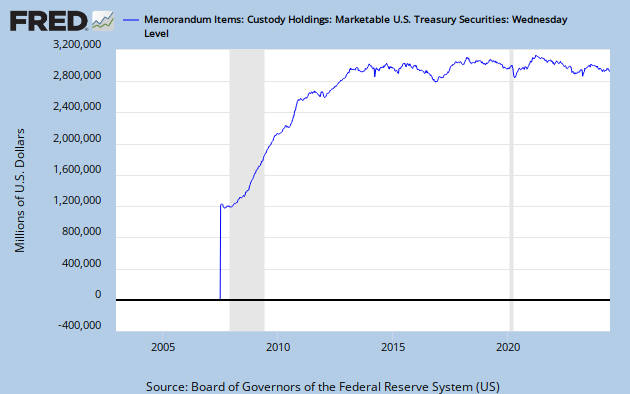
Knowing that foreigners have started selling their U.S. treasuries, the U.S. dollar will have a high probability of breaking down now to 70. We are currently at 79. So prepare to see even worse to come.

Knowing that foreigners have started selling their U.S. treasuries, the U.S. dollar will have a high probability of breaking down now to 70. We are currently at 79. So prepare to see even worse to come.
vrijdag 10 mei 2013
Percentage of U.S. Government Public Debt held by Foreigners
This page is created to monitor the Percentage of U.S. Government Public Debt held by Foreigners.

The debt held by foreigners can be found here.
Top 10 holders of U.S. treasuries can be found here.
From the chart we can conclude that an ever increasing amount of the U.S. Government Public Debt is financed by foreigners. As long as the chart keeps increasing, U.S. bonds are in demand by foreigners. Once this chart starts to decline, it means that confidence of foreigners in U.S. debt is starting to wane.
The following chart gets updated weekly, so this is the most important chart to monitor.
donderdag 17 januari 2013
U.S. Bond Market About to Implode
I just wanted to give an update on the status of the U.S. treasury market. I warned about a bond bubble here, stating that short interest in the commercials was going up dramatically. The last months we have seen weakness in the bond market as a result, but if you think it's already over, I have to disappoint you.
The bond bubble collapse hasn't even started yet. On Chart 1 we can see that since that article, the net short positions for the commercials has even gone up (pointing to a weak bond market and a bottoming out of yields), and the non-commercials have kept buying more and more bonds, thinking it would be a good investment. If these non-commercials unwind their long positions, we will start to see the real bond bubble collapse.
Even though non-commercials are buying like crazy, the yields haven't gone down. On Chart 2 we see that yields have risen even when long positions in non-commercials went up. This is not a normal event.
To find out more, go here.
 |
| Chart 1: Commercial Open Interest in Treasury Notes |
 |
| Chart 2: 10 year U.S. bond yields |
zaterdag 17 november 2012
Foreign Investors Continue to Buy U.S. Treasuries
It is expected: foreigners continued to increase their positions in U.S. treasuries. Foreign holdings of U.S. debt hit $5.46 trillion from $5.292 trillion the previous quarter (Chart 1). That's an increase of 3%.
$16.28 trillion in debt is now partly in the hands of foreigners. The percentage = 5.46/16.28 = 33.5% (Chart 2).
As long as foreigners are willing to hold U.S. debt, there is no problem at all...
One word of caution though, the interest on this debt will be sucked out of the U.S. economy and go to the foreigners.
China increased their U.S. treasury holdings to $1.156 trillion in September 2012 (Chart 3).
One word of caution though, the interest on this debt will be sucked out of the U.S. economy and go to the foreigners.
 |
| Chart 1: Federal Debt Held by Foreigners |
 |
| Chart 2: Federal Debt Held by Foreigners |
 |
| Chart 3: China U.S. treasury holdings |
vrijdag 24 augustus 2012
Analyzing Federal Debt held by Foreigners
As U.S. treasury yields (TBT, TLT) are starting to spike upwards, investors should pay more attention to this new trend. To help investors monitor U.S. treasury yields I'll point out another interesting correlation between U.S. debt held by foreigners and U.S. bond yields. We will see they are inversely correlated. If foreigners sell U.S. bonds, bond yields will go up.
The total public debt consists of two components:
1) Debt held by the public which is $US 11.177 trillion today.
2) Intragovernmental debt which is $US 4.783 trillion today.
The sum of these two is almost $US 16 trillion. The debt held by the public is increasing very rapidly, while the intragovernmental debt is stable.
Of these two components, the first one can be held by foreigners.
To see the foreign holdings you can go to this site: Treasury.gov.
Avondale Asset Management has recently updated the percentage debt that foreigners held on in April 2012. They put up chart 1: Percentage of Publicly Traded Federal Debt Held by Foreigners.
To read the full analysis, go here.
The total public debt consists of two components:
1) Debt held by the public which is $US 11.177 trillion today.
2) Intragovernmental debt which is $US 4.783 trillion today.
The sum of these two is almost $US 16 trillion. The debt held by the public is increasing very rapidly, while the intragovernmental debt is stable.
Of these two components, the first one can be held by foreigners.
To see the foreign holdings you can go to this site: Treasury.gov.
 |
| Table 1: Foreign holdings of U.S. treasuries |
Avondale Asset Management has recently updated the percentage debt that foreigners held on in April 2012. They put up chart 1: Percentage of Publicly Traded Federal Debt Held by Foreigners.
 |
| Chart 1: Percentage of Publicly Traded Federal Debt Held by Foreigners |
Abonneren op:
Posts (Atom)