Posts tonen met het label Mining. Alle posts tonen

zondag 1 maart 2026

dinsdag 28 september 2021

Mining M&A Vs. Gold Price

M&A activity is a leading indicator for the gold price.


Today, M&A in the mining space is subdued (especially in base metals), but rising.


But M&A is about to boom again.


vrijdag 6 augustus 2021

Capstone Mining has highest growth among peers

If you just hold Capstone Mining long enough, the growth will only accelerate. 


vrijdag 28 mei 2021

Why Chile Tax Doesn't Affect Capstone Mining

Capstone Mining has an exemption from Chilean tax hikes for 15 years after commercial production due to DL 600.


maandag 1 maart 2021

Goldman Sachs raises copper price to $4.75/pound by end of 2021

Goldman Sachs raised the copper price to $4.75/pound by end of this year. 

If you want to bet on this rise in copper, the best copper miner to buy right now is Capstone Mining.

At $4.75/pound copper, Capstone can 7 fold by 2024.


dinsdag 25 augustus 2020

Peru copper production surging

Peru copper production is back on track to go to its all time highs, this also means that silver production will be up. This will put pressure on silver prices.


dinsdag 14 april 2020

Mining an essential service

Some countries have allowed mining to reopen in South America.

Argentina: ESSENTIAL
Argentina’s government classified mining an essential activity on April 3, a move which has allowed miners to begin lifting suspensions and operational reductions put in place last month at a string of operations.
These include Yamana Gold’s Cerro Moro gold mine, where normal operations are resuming after a partial demobilization of workers last month.

Bolivia: NON-ESSENTIAL
An obligatory quarantine imposed until April 15 has impacted mining operations, with Minera San Cristóbal and Pan American Silver among the companies suspending assets.

Brazil: ESSENTIAL
The Brazilian government declared mining operations essential in late March.
The move is aimed at keeping mining operations running despite restrictions imposed on business activity and the movement of people by state and local governments.
A number of mining operations have been suspended to meet state level restrictions, including Equinox Gold’s Pilar asset in Goiás state.

Chile: ESSENTIAL
Mining operations are continuing in Chile despite a 90-day state of catastrophe announced in March, which included powers to restrict movement and assure food supply and basic services.
But mining companies including state copper producer Codelco and Anglo American have slowed operations and reduced their workforce to comply with the declaration.

Colombia: ESSENTIAL
Quarantine measures included in Colombia’s Decree 457 allow for mining operations to continue.
Despite this, mining companies such as coal producers Cerrejón and Drummond have suspended or reduced operations to protect workers and neighboring communities.

Dominican Republic: ESSENTIAL
The Dominican Republic has announced a state of emergency but operations are continuing at Barrick Gold's Pueblo Viejo, Latin America’s biggest gold mine.

Ecuador: ESSENTIAL
About 80% of Ecuador’s production is paralyzed as a result of anti-COVID-19 measures, but oil and electricity are exempted while mines continue operations at minimum levels, Pablo Zambrano, head of the federation of production chambers, told BNamericas earlier.
However, Lundin Gold has suspended operations at Fruta del Norte – Colombia’s biggest gold mine, with the Mirador copper mine, operated by Chinese consortium CRCC-Tongguan, operating with a reduced workforce.

Honduras: NON-ESSENTIAL
Emergency measures imposed to tackle COVID-19 in Honduras impacted mining companies, with Aura Minerals’ San Andrés gold mine among those impacted.
However, individual mines including Ascendant Resources’ El Mochito zinc-lead-silver asset have been deemed essential to local communities and allowed to continue.

Mexico: NON-ESSENTIAL
The government has rebuffed industry calls for mining to be categorized as essential activity.
A suspension of all non-essential activities runs to April 30.
The bulk of mining companies have confirmed they are halting Mexican operations. Those which have not yet announced suspensions include Fresnillo.
An exemption to the suspension order may be sought for individual mines that will suffer irreversible damage from a shutdown, although no exemptions have been confirmed to date.

Nicaragua: NO RESTRICTIONS
Nicaragua’s government has taken a light touch in its response to the pandemic, with no social distancing measures in place, but Calibre Mining has halted operations at its gold mines.

Panama: ESSENTIAL
A 30-day suspension of non-essential activities in Panama exempted First Quantum Minerals’ Cobre Panamá copper-gold mine.
But operations have since been suspended following COVID-19 cases and the death of a subcontractor.

Peru: NON-ESSENTIAL
Social isolation measures announced in March and since extended to April 12 led to a long list of mine suspensions.
But exceptions have been granted.
A regulatory framework issued by the energy and mines ministry and interior ministry allows mines to operate during the lockdown with essential personnel, Fortuna Silver said in a release.
The company is continuing to operate its Caylloma mine under this framework, with a reduced workforce drawing stockpiled ore for processing.
Freeport-McMoRan also announced talks with government leaders in March aimed at allowing limited operations at the Cerro Verde copper JV to continue.


vrijdag 27 maart 2020

Gold Miners Shutting Down

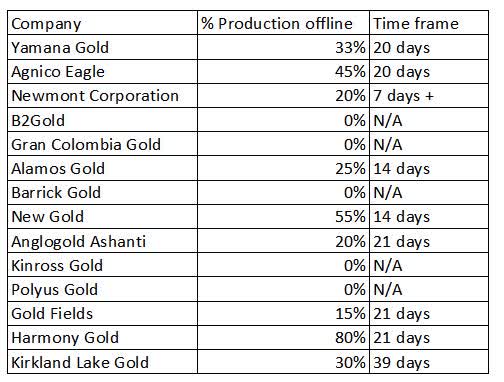
Gold Miners all over the world are shutting down, this could disrupt supply of gold and should be beneficial to the gold price.


For more information, go here.

As for silver, Mexico (producing 23% of global silver), has also shut down mining for 1 month. I estimate that at least 75% of global silver supply is down based on the chart below.


zaterdag 1 oktober 2016

Calibre Mining

In this article I present you one of the best opportunities to leverage against a rising gold and silver price. The following exploration company caught my attention when last week Pierre Lassonde increased his ownership to 14.13% by exercising common share purchase warrants for proceeds to Calibre Mining (CXBMF) of CDN $1,250,000. 

You might say this is another gold/silver/copper exploration company, but the following reasons will change that perception.

Read further here.

donderdag 29 januari 2015

Oil Versus Gold

What everybody has been ignoring these days is that gold has gone up and oil has gone down.


Let's look at the impact. More info here.

For 1 ounce, miners use 26 gallons of diesel or about 100 liters. We know that diesel costs around 3 dollars a gallon. So we have 3 dollars/gallon x 26 gallons = 78 dollars. 1 ounce = 1300 dollars. This means that energy is 6% of the cost to produce gold.
Top 5 Gold Miners Gold Production & Diesel Consumption

But, the costs are actually higher. The chart below says that one ounce costs 100 dollars on energy. So it's more like 8% of the total cost of gold production is energy. Oil dropped 60%, which means the costs of gold mining just dropped: "cost"*8%*0.6. Let's say we have an AISC of $1200/ounce. That would now be $1140/ounce. I think that is a very significant drop in cost.

Top 5 Diesel Consumption & Cost Per Ounce 

Of course materials and workforce also rely on energy and we didn't take that into account... So mining companies are benefitting greatly from the drop in oil price. The funny thing is that gold miners haven't seen the gains yet, which means I'm buying the mining industry hand over fist now.

donderdag 9 oktober 2014

Gold up, oil down?

Gold up, oil down? This reminds me of the depression of 1930s. If this continues, it will be wildly bullish for gold mining stocks.


dinsdag 7 oktober 2014

Which gold miner to choose based on AISC

As a follow up of my previous post on the AISC of several prominent silver miners, I took a look at the AISC of the most important gold miners.

As many precious metals investors know, the price of gold (NYSEARCA:GLD) was smashed to 2010 lows of $1185/ounce (see chart from Kitco below).

Gold premiums have been moving up particularly at the Shanghai Exchange while premiums were at 0% throughout the first part of 2014. At the same time we see that someone is raiding the GLD ETF again, just like in 2013. I suspect China is doing this again as SGE withdrawals are at records again.
We see heavy physical demand appearing for gold, so there is light at the end of the tunnel. But nevertheless, investors should mitigate the risks in their gold miners portfolio and we can do that by looking at the costs. In June, 2013, the World Gold Council, an industry group, produced a detailed standard for what miners should include in all-in sustaining costs, or AISC. We will use that metric. If gold prices keep slumping below the all-in sustaining costs of gold production, the company won't be able to make a profit. That's why I summarized a table of the most recent AISC numbers of several notable gold mining companies and compared it to the 2013 numbers.

To read the analysis, go here.

woensdag 30 juli 2014

Gold Mining Stocks Volume Speaks For Itself

If you didn't know it yet, Michael Pento went long gold mining stocks last month and I can know why. I only need one chart.

If we just look at the junior miners GDXJ, we can see that trading volume has grown into an exponential rise. See red circle below.

Such rising volume on a rising price level in GDXJ says to me there are conviction buyers in this sector and it marks a true bottom.

maandag 7 januari 2013

A little background on the effect of gold mining supply on the gold price

In a previous article I pointed out that the marginal cost of gold production including exploration, feasibility studies, construction, maintenance, production and taxes has doubled since 2009 up until now. That has placed a large burden on gold mining companies over this period. The result was a decline in the gold mining index (GDX) of around 10% since 2010. Even when the gold price steadily went up from $800 to $1600/ounce, there wasn't a lot of profit to be made by the gold mining companies themselves. This means that gold mining companies are very dependent on the gold price for their margins and profits. At the same time, I want to make a case that the gold price is also very dependent on the mining companies.

If anyone ever says that gold mining production isn't going to affect the gold price, you can use these charts to prove them wrong.

In 2012 we had 4000 tonnes of total gold supply per annum, while gold mine production was around 2812 tonnes per annum in 2012. That's a 70% interest of gold mine production as compared to the total gold supply.

If the gold miners continue to have lower prospects for production due to the marginal cost of production rising above the gold price (total marginal cost is currently $1500/ounce), then the supply of gold will drop. As a result we will see a rising effect on the gold price when this supply breaks down.

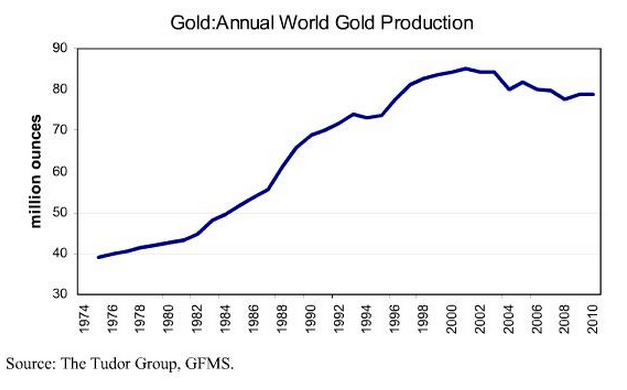
Mine supply had been going up since 1974 (Chart 1), but has peaked since year 2000. I believe mine supply is going to stay flat or even drop going forward due to decreasing ore grades and higher marginal costs of production.

(click to enlarge)
Chart 1: Annual Gold Production


To read more, go here.

zondag 23 december 2012

The Marginal Cost of Gold Production

UBS recently put out a number for the cost of producing an extra ounce of gold. As you can see on chart 1, the cost has skyrocketed from 2008 onwards to today. Costs almost doubled in 2 years time.

It shows us that if the gold price were to go to $1500/ounce, nobody would go out and search for gold as it would be unprofitable.
Chart 1: All-in Cost of Gold Mining
Chart 2 gives an operating cost of $700/ounce for gold, but it's important to notice that the large bulk of the costs go to construction, maintenance, exploration and taxes. Also note that the lowest gold went in 2008 is exactly at $712/ounce in October 2008, which was 10% below marginal cost of production at that time. That low in today's terms would be $1350/ounce.
Chart 2: Replacement cost for an ounce of gold
With all of this in mind, I believe gold will never go below $1350/ounce. This will be the ultimate floor. If it does, it will quickly rebound.

And for people who are interested in the marginal cost of production in silver, it is around $30/ounce as suggested in this article. So I expect silver to rebound soon.

maandag 17 december 2012

The Trend in Base Metals based on Capacity Utilization and China Manufacturing PMI

To forecast the trend in the price of base metals we have a lot of indicators to look at. Two of the most important indicators to look at in my perspective are capacity utilization and the China manufacturing PMI.

Previously, I noticed that capacity utilization for mining in the U.S. was improving in November 2012, with the rate growing to 91.1%. Though, the problem is that the U.S. isn't that important anymore when talking about commodities. For example, in 2012 the emerging markets account for 75% of global iron ore consumption (Chart 1), while Asia, South America and Oceania account for more than 70% of global iron ore production (Chart 2). The same trend can be found in gold and silver production/consumption.

Chart 1: Iron Ore Consumption by Continent
Chart 2: Iron Ore Production by Continent
It would be wrong to only look at the capacity utilization of the U.S. to draw any conclusions on the prospects in the commodity market. It's essential to include China, South America and Australia/Canada into the equation.

To read the analysis, go here.

dinsdag 17 juli 2012

Capacity Utilization in June 2012 at 78.9%

Good news! The capacity utilization rate for the total industry in June 2012 came in at 78.9%, up from 78.7% a month ago (Chart 1).

Interestingly, the mining industry posted its biggest gain in capacity utilization. Mining had a capacity utilization of 89.4%, up from 89.0 % a month earlier.

So no worries, inflation is still in the game.

Chart 1: Capacity Utilization Rate