Posts tonen met het label bubble. Alle posts tonen

donderdag 15 februari 2018

The Central Banker's Bubble

On February 14th, 2018, the consumer price index (CPI) came in higher than expected. It posted 2.1% instead of 1.9%. 10 year bond yields surged to 3% on this news and the U.S. dollar fell. It will be interesting to see how the Federal Reserve will react to this news in March's FOMC meeting. Will it increase interest rates on this higher inflation data, or will it hold rates? I believe the Federal Reserve is not able to raise rates much more and I will tell you why.

Read further here.


woensdag 24 september 2014

Peter Schiff Was Right Bitcoin Version

As the Bitcoin bubble has burst (Bitcoin price under $400), I wanted to look back on Peter Schiff's call on the Bitcoin bubble.


Here is one of his funniest moments from November 2013.


zondag 14 september 2014

Belgium Housing Stagnation

Three months ago I reported that Belgium's housing market was starting to decline. Statistics Belgium reported this month the actual numbers for the first half of the year 2014.My suspicion was correct.

Villa's throughout Belgium, especially in the southern region, have fallen. Villas fell 0.3% year over year.
Also normal residence housing has stopped rising. Brussels had a year over year decline of 2.8% in the residential area.

Instead, people are now buying the cheaper alternatives: appartments and building grounds. These rose 1.7% and 3.7% respectively.

In the chart below you can see that the red and blue chart are starting to decline. I'd say the bubble is about to burst. We'll see in a few months.
Housing prices Belgium

woensdag 25 juni 2014

Stock market overextended

When GDP growth gets consistently revised downwards while the stock market goes up every day, we get an overextended TMC/GDP ratio at 121.3%. Yes, we are in a stock market bubble. The question is, when will it pop? Keep your finger on the sell button.

First it was 0.1% GDP growth, then it was -0.1%, then it was -1% and suddenly today they reported -2.9% GDP growth. Incompetent people...


donderdag 29 mei 2014

Belgium Housing Bubble Starts to Pop

As I predicted a year ago, it is starting to happen. The declining home sales in 2012 are now starting to have its effects. The Belgium housing bubble shows signs of a pop. In Brasschaat (where I live), I indicated that many houses and especially villas were on sale.

Now the reports are out. We are seeing prices drop more than 20% this year around the Antwerp region. Brasschaat and Schilde were most affected.

Could this be the start of a declining housing market in Belgium, just like we saw in our neighbour country the Netherlands?


donderdag 10 april 2014

Bitcoin Crashes Under $400/Bitcoin

Bitcoin crashing through $400/Bitcoin. This level was exactly the point where the hype started, which means we have come under support levels. And yes, Bitcoin will crash to zero now.

Especially when the government says Bitcoin is an asset and you will be taxed on it, maybe even retroactively.

And China banned Bitcoin completely. Bye Bye cryptocurrency...


maandag 17 maart 2014

Marc Faber: When China Implodes, This Might Be Bullish For Gold

A very important development is happening today in China.

One after another company in China is defaulting on its debt. Marc Faber quotes: "We have a gigantic credit bubble here in China." Example: Zhejiang Xingrun Real Estate Co real estate developer defaults. Chinese bank defaults.

What this does to the yuan is obvious, the yuan is declining. If it manages to go above 6.2 USD/CNY, you can expect large problems as the China carry trade will halt and many people invested in Chinese structured products will be in the dumps.


Marc Faber confirms this in the next video. He expects Chinese GDP growth to slow 50% from 8% to 4%. You would think that when the yuan drops, Chinese can't buy that much gold anymore, but Marc Faber has another view on this. The yuan could drop and as a result Chinese gold demand could actually go up due to people protecting themselves from inflation (and defaults) in China.


vrijdag 7 februari 2014

Bitcoin Crashes

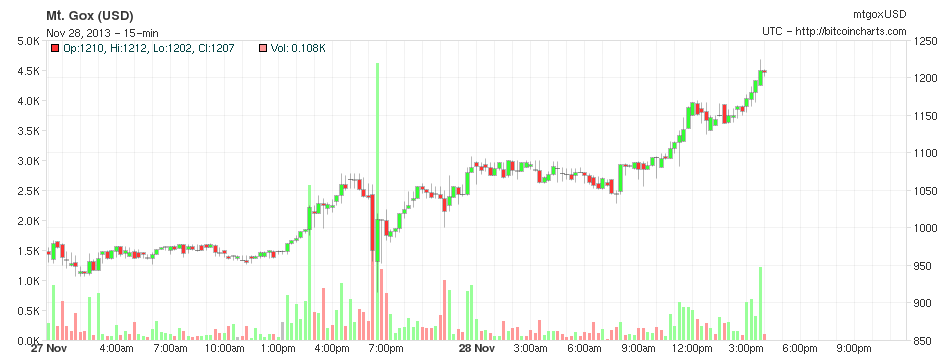
As predicted many times ago, bitcoin is a bubble. Finally, people are starting to realize this. Mt. Gox has now temporarily suspended withdrawals of money from their exchange. Everyone is now rushing to get their money selling their bitcoins. But the funny thing is, this will take more than a month to do so and it will also take 4 weeks to validate your bank account. So in total you won't have your money for probably several months and now they suspend your withdrawal.

Do you really think people want to put their money in a virtual currency, knowing that their exchange could crash/go bankrupt at any time and their money disappear in a second?

Needless to say, the bubble has popped and that is visible in the following graph and it's going to get worse.

Peter Schiff was right... bitcoin is a bubble. You won't have these problems with gold, I can tell you that.


vrijdag 29 november 2013

Why Bitcoin is a Bubble

In this article I'll show you why I think Bitcoin is a bubble, contrary to the bullish mentality we see today around Bitcoins. I don't know how high it will go, but I'd stay away from it.

Remember the most important rule in spotting a bubble: "90% of the move comes in the last 10% of the time".

In a year, Bitcoin soared from 12 USD/bitcoin to 1000 USD/bitcoin. In total we have a rise of 1000 - 12 = 988 USD/bitcoin.

10% of 1 year = a little over 1 month. The price was 180 USD/bitcoin a month earlier. So in the last month, bitcoin soared from 180 USD/bitcoin to 1000 USD/bitcoin. That's a 820 USD/bitcoin increase in the last 10% of the time frame of 1 year. 820 USD/bitcoin is also almost 90% of 1000 USD/bitcoin.

So in theory: "90% of the move (820 USD/bitcoin) comes in the last 10% of the time (one month)."

Which means, the bubble should now burst if I'm right...


Moreover, as silver and gold continue their downward spiral, bitcoin continues surging. At this rate for example, we have a $20 billion silver market (above ground silver) and a $12 billion bitcoin market.

At some point very soon, the bitcoin market will overtake the silver market.

You can physically buy up every ounce of silver in this world with bitcoins, by just going to this site for example: http://bitcoincommodities.com/

Eventually these people need to do something with their bitcoins. Why wouldn't they buy up the entire silver market?


Additionally, this week we finally crossed the line where 1 Bitcoin costs the same as an ounce of gold. One Bitcoin costs $1230.


If you could choose between a Bitcoin or gold coin, I would certainly go for the gold coin and here is why.

First, we had Bitcoin (2008), then we had Namecoin (18-Apr-2011), Litecoin (7-Oct-2011) and now we have Peercoin 12-Aug-2012 and Primecoin (7-Jul-2013) and Feathercoin (16-Apr-2013) and Novacoin (9-Feb-2013) and many more to come.

If everyone invents new coins, there is only so much money that people can use to buy these coins. At some point we will get a crash in the value of these coins as more and more coins come out of nowhere.

The following site gives a list of the most important cryptocoins:

http://coinmarketcap.com/

To show you why I think Bitcoin is a bubble I took the cryptocurrencies with the highest market cap in this table.


You can see that we first had Bitcoin in 2009 and as we progress, more and more competing cryptocurrencies arose.

It gives us this chart:


More and more "bitcoins" emerge out of nowhere and that's why I think we will see Bitcoins implode at some point. This parabolic curve is the physical evidence of a bubble.

Second, Bitcoin's use is mostly speculative, you don't buy Bitcoin because you think it has value. People buy it to earn speculative profit from it. That's the biggest difference as opposed to gold. Also, you can't buy a lot with Bitcoin today. The most important retailers like Google, Amazon and eBay have their own payment system.

Third, gold has an intrinsic value while Bitcoins don't have an intrinsic value. Gold can never be duplicated and it is very difficult to mine it out of the ground. Also, gold is a universally accepted "currency", with an above ground stock of 170000 tonnes or a market capitalization of $7.5 trillion. If you know that the amount of U.S. dollars in this world is about $10 trillion (M2 money supply), then you can easily see that gold is competing with fiat currency. Now if we look at the tiny market capitalization of Bitcoin, we only have $12 billion. So the Bitcoin world is only 0.16% of the gold market. People would argue that this means that Bitcoin has much room to grow because of this difference in market capitalization. If you believe Bitcoin can compete with gold, then Bitcoin would need to go up a thousand times from its level today. I don't believe this will happen because of the reasons I pointed out earlier.

Conclusion:

Unlike Bitcoins, gold cannot be duplicated, nor can it be invented out of nowhere. I'd just stay with physical gold (GLD) (PHYS).

woensdag 20 november 2013

Bitcoin Bubble

Remember the rule: "90% of the move comes in the last 10% of the time".

In a year, Bitcoin soared from 12 USD/bitcoin to 1000 USD/bitcoin. In total we have a rise of 1000 - 12 = 988 USD/bitcoin.

10% of 1 year = a little over 1 month. The price was 180 USD/bitcoin a month earlier. So in the last month, bitcoin soared from 180 USD/bitcoin to 1000 USD/bitcoin. That's a 820 USD/bitcoin increase in the last 10% of the time frame of 1 year. 820 USD/bitcoin is also almost 90% of 1000 USD/bitcoin.

So technically: "90% of the move (820 USD/bitcoin) comes in the last 10% of the time (one month)."

Which means, the bubble should now burst if the theory is right...
The problem is, I think this time is different with Bitcoin.


woensdag 26 juni 2013

The Housing Bubble is Deflating

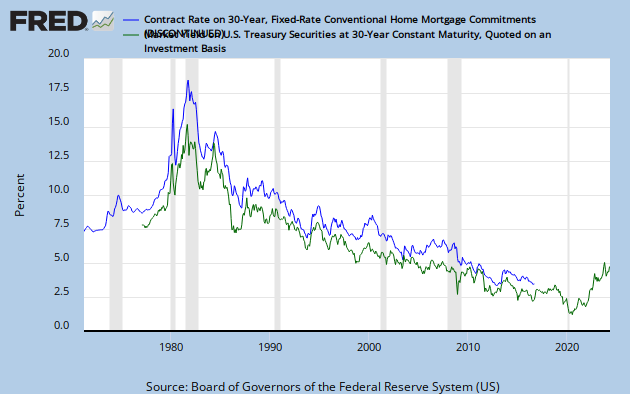
With the recent surge in the mortgage yields, let's see how the housing market is doing. The two key metrics to look at are mortgage rates and household income. Let's analyze the mortgage rates first.

Historically, there is a high correlation between 30 year U.S. treasuries and 30 year mortgage rates (Chart 1). The chart shows that the 30 year treasury yield has spiked upwards starting in 2013, so I expect that the 30 year mortgage rates will spike upwards too. 30 year mortgage rates have already gone up from 3% to 4.9%, which had negative consequences for the real estate market, which is not priced in yet in the housing index.
Chart 1: Correlation between 30 year treasury yield and 30 year mortgage yield

As Zero Hedge reports, the affordability of housing is declining rapidly with rising mortgage yields. Every percentage increase in yields on 30 year mortgages will result in a 10% decline in affordability as the chart shows. If yields continue to go up to 6%, affordability would have declined about 40% since 2013.

Chart 2: House Purchasing Power
The question is, will mortgage rates go up further? And what about the savings rate of the average citizen?

The answer is that real estate should be sold out of. Kyle Bass for example sold out of three of his real estate holdings: Newcastle Investment Corp (NCT), Hyatt Hotels Corporation (H) and Realogy Holdings Corp. (RLG ) - Real Estate Services.


=> Read it here.

zaterdag 25 augustus 2012

Belgium: Real Estate Starts Falling

I live in Belgium and follow the real estate market closely. I said previously that Belgium's housing is in a housing bubble. Now that prediction starts to come true. We already knew that in the first quarter, real estate was dropping. Today we have new numbers and we see that Flanders is continuing with its drop in apartment prices. Also construction site costs are falling.

Goldman Sachs is saying Belgium real estate is 60% overvalued. That means prices are still to fall 40% in the future.

We already see how the sales are doing, not good (Chart 1).
Chart 1: Home Sales in Belgium