vrijdag 22 juni 2012

Copper Turns Back to Contango: Bearish for Copper Price


In a previous article I pointed out how copper contango/backwardation correlates with the copper price. Since June 11th 2012, copper went back into contango which isn't boding well for copper prices (Chart 1). The China PMI is also going down lately, which means demand for commodities from China will be sluggish.

As copper correlates with the S&P, I would imagine that stock markets will go down as well in the future. So investors should act accordingly and sell equities at this moment.

Chart 1: Copper Contango Curve

China Increases U.S. Treasury Holdings in April 2012

China has been increasing its U.S. bond holdings in April 2012 (Chart 1). Not much news here.

What's very important to know is that China has actually decreased its short term U.S. bond holdings by 5.1%. China holds $US 3.7 billion short term U.S. paper. On June 2011 China held $US 4.9 billion of short term U.S. paper. So basically all the debt that China holds are long term treasuries now. Interesting to know, China had $US 200 billion in short term U.S. debt in May 2009. So they divested all short term paper to long term paper.

In one of my previous articles I pointed out that short term debt is the most risky asset today, and it's being held mostly by foreigners. When the bond bubble implodes, the defaults will start with short term debt. That's also why the federal reserve is enacting Operation Twist II to sell short term paper and buy long term paper.

But China is smart enough not to buy those short term bonds...

China US Treasury Holdings
Chart 1: China U.S Treasury Holdings

Marc Faber: Gold Has Bottomed Out

According to Marc Faber, it's better to invest in corporate bonds than treasuries. Even equities in Asia will do better because of the high dividends, which are around 5-7%.

He also believes that gold has bottomed out at these levels.


CME: Silver Stock Growing, Gold Stock Flat

Time for a gold and silver stock update at the COMEX.

In a previous article I noted that silver stocks were historically low. But recently silver stocks have been rising at the CME, which isn't bullish for the silver price. It means that silver isn't being used as much as a month ago, indicating a slowdown in the economy (Chart 1). Silver has been stocked up in the warehouses.

Chart 1: CME/COMEX silver stock (Troy ounces) (red eligible, blue registered, green total)

As for the gold stock, the total amount of stock at the COMEX has been flat for a month now (Chart 2). If we compare gold stocks against silver stocks, this means that gold is doing much better than silver in strength.

Chart 2: CME/COMEX gold stock (Troy ounces) (red eligible, blue registered, green total)
Notable is the little spike in registered silver on Chart 1 in the beginning of May, and the little spike in registered gold on Chart 2 in the beginning of June.


donderdag 21 juni 2012

How do we know when it's time to sell our gold?

I have pointed out previously how James Turk uses his Gold Money Index to estimate the fair value of gold. You can read it in this article. In that article we estimate that gold should be at $US 10000/ounce in 2011 if we compare the gold price to the amount of foreign currency reserves held by the central banks around the world.

To read the full analysis go to: HERE.

woensdag 20 juni 2012

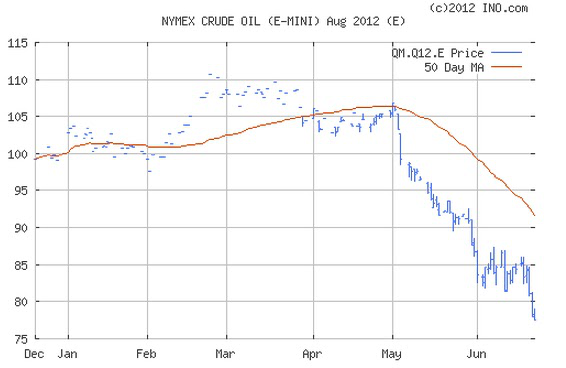
An Analysis on the Oil Price

Since May, the price of crude oil (OIL) has fallen from $US 106/barrel to $US 78/barrel (Chart 1). It is very likely that the price of crude oil will continue to decline because for the first time in a decade, supply is exceeding demand.

In this article I will give advice to investors on how to play the oil price and I will give critical information on when to buy the dip in crude oil based on a fundamental analysis of crude oil production costs.


China Buys Out London's Crown Jewel

As China becomes more and more a leader in the global economy it is not only purchasing the largest amounts of commodities, but is also starting to buy up strategic assets. This time China bought a legacy of 135 year, right in the heart of London.

Over this weekend (16 June 2012), China bought out the London Metal Exchange (LME) for 1.38 billion pounds. This means that J.P. Morgan, Goldman Sachs and Metdist are giving up on their shares of the LME. The LME is now part of the Hong Kong Exchange (HKEx).

This event will increase China's monetary flexibility on the base metals front. It is an important addition to China's assets because China is the largest consumer of commodities in the world. The LME isn't a small exchange as it has an 80% share in global futures trading in key base metals like aluminum, copper and zinc. The plans for China with the LME acquisition is to incorporate more Chinese companies on the exchange and to introduce Chinese currency based contracts trading. It will also enable China to use local warehouses for their customers as the warehouses in China are already over capacity (see my previous article about copper in Chinese warehouses in Shanghai).

It is interesting to note that there were other bidders for the LME, namely the CME and NYSE, but they couldn't compete against the Hong Kong Exchange. The LME only makes about 10 million pounds a year in profit, while the buy out price is at 1.38 billion pounds. That's a multiple of 138! Nobody would buy a company with a P/E ratio of 138, but China did. If we look at another metric (trailing net income), China actually bought the LME at a price of 180 times trailing net income, which is the most expensive deal since 2000. This is because the LME has a lot of strategic value in it for China. One of the most important values is that China now can set the pricing and warehousing of commodities around the world. This is because the LME has 732 approved storage facilities in 37 locations in 14 countries from Singapore to the U.S. This fits perfectly with their strategy in becoming the largest commodity consumer in the world.

Following this highly dilutive transaction by the Hong Kong Exchange, investors should first know that the earnings forecast of the HKEx isestimated to go down around 3-5%. Not only due to the high premium of the buyout of the LME, but also due to costs that will occur during the roll-out of the Asian platform to boost the LME's business in China.

Second, I expect that tariffs on contracts will be increased over time. This is because HKEx has the ambition to become the leading exchange platform in China, competing with the Shanghai Futures Exchange. However, the increase in tariffs will not occur before 2015 as confirmed by the HKEx.

Third, due to an inflow of new Chinese customers to the LME, China-related trading will start to increase. Currently, China-related trading volume on the LME stands at only 20%. This buyout event will enable countless Chinese businesses to start trading on the LME. Where in the past, Beijing had restricted Chinese domestic firms to trade on foreign exchanges. As a consequence, China can reduce delays, transit times, business costs and enhance commodity trade flows to China. In other words, China, who accounts for consumption of 40% of the world's commodities, will be able to acquire commodities at a faster pace in the future. It will also be able to start trading in other essential metals like iron ore and steel making coal. I believe this is bullish for commodities in general. Investors can bet on commodities through ETF's like the PowerShares DB Commodity Index Tracking Fund (DBC).

But the most important aspect is that China will have the power to create products on the LME that are denominated in yuan. This is again another step forward for China to compete agains the U.S. dollar as reserve currency of the world. Investors should take this opportunity to invest more of their money in RMB by buying funds that track the yuan, e.g. Market Vectors Chinese Renminbi/USD ETN (CNY).

maandag 18 juni 2012

Capacity Utilization Rate May 2012 Flatlined at 79%

The newest number on capacity utilization is 79 % for the total industry in May 2012. This is basically the same as the previous month.

Interestingly, the capacity utilization for the mining industry is much higher at 89.2 %, up from 88.5 % the previous month. This is positive for the mining shares. 
Utilities inched up to 76.5 % from 76 % the previous month.

Chart 1: Capacity Utilization Rate